
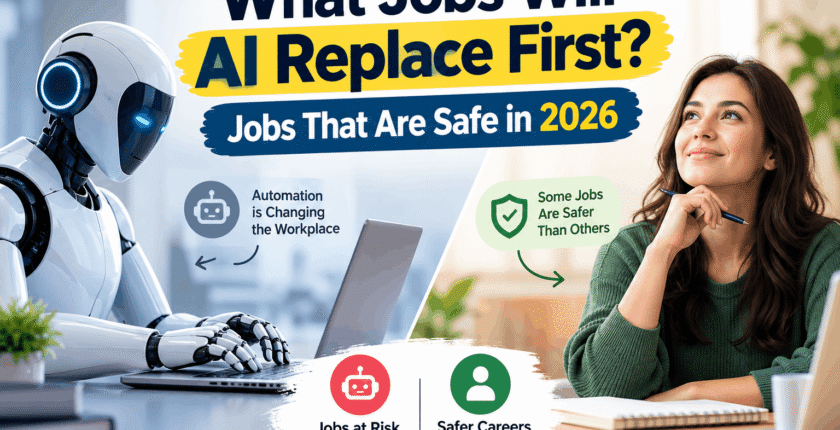
What Jobs Will AI Replace First? Jobs That Are Safe in 2026
A few months back, I was speaking to my client whose business is that of online retailing on the phone. The point they made was that they had just fired their customer service rep and gotten themselves a chatbot via the AI platform.
“It answers faster than Priya ever did,” she said.
After two weeks, she contacted me again. This time, however, she was not boasting. Refund requests were getting mishandled. A customer had been told, confidently and completely wrong, that a damaged item wasn’t covered under warranty. She’d spent the “savings” from the layoff on damage control.
That phone call is basically the whole story of AI and jobs right now, compressed into two weeks. It’s not a slow-burn Armageddon, and it’s nothing. It is dirty, it is messy, and it is happening much faster in some parts of the workforce than many of us realize.
Over the past two years, I have been using these technologies regularly, whether it be GPT and Claude for writing and research, GitHub Copilot for code and scripts, or Midjourney for rapid visuals, while also witnessing firsthand the layoffs and automation in action that my friends and clients experience. Instead of another “10 top jobs AI will take away” listicle, I wanted to tell you what I saw, what was backed by data, and what wasn’t.
The Reality, Not the Media’s Version
The numbers are bigger than most people assume. The outplacement firm, Challenger, Gray & Christmas, keeps track of the reported cause for every layoff notice in the US, and by mid-2026, AI was the most frequently reported reason for layoff notices — with over 100,000 reported layoffs associated with AI just in the first six months of that year, beating out 2025 entirely.
Tech has been hit especially hard. The number of job cuts in the technology sector in Q1 of 2026 almost doubled compared to the previous year, with about half of those cuts involving either artificial intelligence or automation.
But let’s see what the media is missing: It’s not always an “either robots win, or humans lose” story.
Klarna is the case everyone brings up, for good reason. As is well known, the company fired about 700 customer service staff members in favor of an artificial intelligence assistant, boasting that this assistant was doing the job of several hundred workers. However, this led to declining satisfaction among customers, numerous complaints, and a public apology by the company’s CEO for the poor quality of the provided assistance. Klarna quietly began rehiring humans again, but this time in a hybrid manner where the AI did all the easy work, while humans did all the difficult things that required judgement.
It does not intend to mean that “AI has been overhyped; no need to panic.” In fact, this is what I want to convey.
The Pattern I Keep Seeing
After watching this play out across a bunch of industries, the jobs going first almost always share three traits:
- The work is repetitive and rule-based
- It happens entirely on a screen, with no physical component
- Getting it “mostly right” is good enough—a mistake doesn’t cause a crisis
The jobs that are resistant to automation because of their characteristics are physical presence, responsibility if anything goes wrong, and someone at the other end who wishes to have someone else at the other end as well.
That is why a chatbot could mess up a support line but cannot yet redirect a truck around a flooded street, and an AI could write an acceptable first draft of a blog post but cannot sit in front of a distraught family and diagnose their situation.
Jobs Getting Hit First
Based on what I’ve watched happen to actual teams (including some of my own freelance writers), here’s where the pressure is heaviest right now:
1. Tier-1 customer support. Chat and email support for simple, repeatable questions—order status, password resets, basic troubleshooting — is where tools like Intercom’s AI agents and similar platforms have made the biggest dent. What the Klarna story illustrates is the limits, but there are many other firms that have quietly made this happen through automation without getting into any trouble with the public.
2. Data Entry & Basic Accounting: When you work on entering data into different systems, automation combined with AI technology will do this job much faster and will not get tired by the time it is four o’clock on Friday afternoon.
3. Content & copywriting for entry level. This is related to product description writing, SEO articles, and social media caption writing. I always hire people as freelancers to do this task for me. But somehow this job has become very small, and I feel really awkward being part of this.
4. Contract analysis performed by paralegals. Filtering out contracts and marking standard contract terms is an example of an activity that involves matching patterns, which language models can excel at.
5. Telemarketing and sales outreach activities. Cold call scripts and emails sent for first-time outreach are often generated by AI.
6. Entry-level coding tasks. This one surprised even me. There have been many reductions in the job openings for junior developers since 2022 because of the existence of AI tools such as GitHub Copilot and Cursor, which now do all the coding and testing that was once done by a junior developer. The tasks have not disappeared; they’ve only become reviewing and guiding AI-generated material.
7. Basic translation and transcription. Real-time translation apps and transcription tools (Otter.ai and similar) have made a lot of “good enough” translation and note-taking work redundant.
If your occupation falls under one of those categories, then this doesn’t mean that you’re a goner by next Tuesday. Rather, the ground underneath that particular profession is shifting, and it’s better to plan instead of scrambling after a layoff notice comes your way.

Steps to Assess Your Own Risk
I’ve run down the checklist with a few friends of mine who have wondered whether or not they “should be worried.” This takes twenty minutes and is more useful than any doomsday headline.
- List your actual tasks, not your job title. Write down everything you do in a typical week. A “marketing coordinator” role might be 60% repetitive reporting and 40% relationship management—those two halves have very different risk levels.
- Categorize each task as either “repeatable” or “judgment call.” A repeatable task follows the same process every single time. A judgment call involves considering the situation, reading the room, or owning the result of something.
- See who’s responsible when there’s a mistake. When there’s an error by the AI and it’s something easy to resolve, then the task is vulnerable. When there’s a lawsuit, an injury, or a broken client relationship, humans are involved longer.
- Automate a repeatable task from your own job. Open up ChatGPT, Claude, or Copilot and see if you can do the boring 20% of your work with AI for a week. You’ll learn more about your real exposure from this than from any article, including this one.
- Notice what AI still gets wrong. Keep a running list. This becomes your argument for why your opinion is still relevant—and you can use it to great effect in your next performance appraisal or interview.
The Mistake That I Made (To Help You Not Make It)
Here is some truth with you. Last year I tried to fully replace a freelance proofreader with AI to save money on a client project. Seemed reasonable—proofreading is repetitive, rule-based, exactly the kind of task I just described as “exposed.”
It went fine for two weeks. Then the AI missed a factual error in a client’s finance blog post—a wrong percentage in a stat that made it into a published article before a human caught it during a routine check. There was nothing revolutionary in this, but it was very embarrassing, and it was totally unnecessary.
This was not “Don’t use AI to check your proofreading,” but rather that even what seems to be a straightforward task is almost always one that has a judgment component within it—that a number looks wrong, that a statement needs to be verified by a second source, that there is just something that seems wrong about something.
Genuinely Safer Jobs (For Now)
They’re not “AI-proof” per se, since there isn’t anything truly AI-proof, but they incorporate enough physicality, license, or human trust such that full automation becomes much more difficult to implement.
- Technical occupations – Electricians, plumbers, HVAC technicians. Someone has to be there in person to repair the burst pipe in the crawlspace. Demand here is actually climbing partly because of data center construction for AI itself.
- Nursing and hands-on healthcare—direct patient care combines physical work, split-second judgment, and legal accountability that isn’t going anywhere soon.
- Psychological therapy and counseling.
The desire to speak to a person instead of a chatbot (which does not cost anything) remains a constant in many people’s lives. - Educational activities, particularly early childhood education. The management of a group of eight-year-olds cannot be seen as language modeling.
- Firefighters, paramedics, and policemen. Creative Director & Strategist Roles – Creative Directors, Brand Strategists & Designers. Although AI can provide the choices quickly, there is still someone who has to choose the choice that would fit the brand and the situation.
- Engineer and AI management jobs—paradoxically, among the most secure tech jobs are those that are centered on designing, auditing, and protecting the AI itself.
Here is the pattern: studies on the careers that last always come up with the same three components: physical flexibility in uncertain situations, legal accountability, and the assumption that there is an individual who actually wants to be part of the process.

Current Common Mistakes That People Make
Panic and exit a stable industry instantly. There have been people who have abandoned perfectly fine industries based on news reports without verifying their own field.
Assuming a degree alone protects you. Plenty of “safe” fields have exposed sub-roles inside them. While getting an education in computer science is helpful, junior programmers who have skills in nothing but typing up generic code are more vulnerable than those who understand system design.
Not touching any of the tools in question at all. Those that I have seen getting taken aback by all of this are the ones that never bothered to open up ChatGPT or Copilot even once. They can be completely avoided by you, but you have to know what they are capable of and incapable of.
Overcorrecting, as Klarna did. Going 100% AI on anything customer-facing, without a human safety net, is a specific and well-documented way to damage trust fast. If you’re a manager reading this, that’s the mistake to avoid on your end.
Ignoring the “hybrid” middle ground. Almost every real success story I’ve come across isn’t “AI replaced humans” or “humans beat AI”—it’s a hybrid workflow where AI handles volume and humans handle exceptions and relationships.
Where I’d Leave This
In case you would like to get an even more detailed explanation of the actual AI writing and productivity tools that I use each week, I have an article on this topic available, as well as another one about building a new resume in view of the highly AI-based recruiting process.
No one can be sure of the future safety of your job position in the next five years. Anyone who says differently is trying to sell something. What I can tell you, from watching this unfold in real client conversations and real layoffs, is that the jobs surviving best aren’t necessarily the highest-paid or the most prestigious ones. They’re the ones where a human being showing up, in person, with judgment and accountability, is still the whole point.
That’s worth building your next move around.