
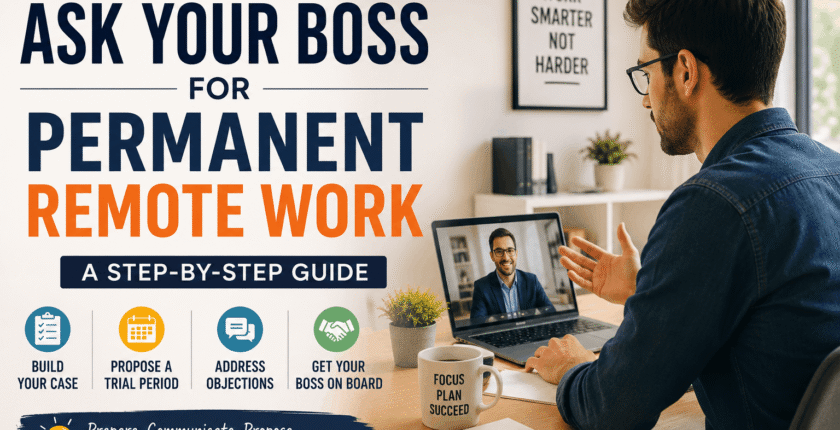
How to Ask Your Boss for Permanent Remote Work: A Step-by-Step Guide
I remember the Tuesday morning when we all received an email from work titled “Important Update Regarding Attendance in the Office.”
Three years of working from my dining table, and all of a sudden there is a requirement to be in the office for four days a week. My commute alone was going to cost me almost two hours a day. The two hours I’d spent waiting for my kid at school, preparing the meal myself instead of eating out, and, let’s face it, sleeping in an extra twenty minutes.
And so, I did what many others have done initially: I complained about it on our group chat. That fixed nothing.
Then I actually asked. And it worked. It wasn’t easy at first, and I certainly had a few idiotic screw-ups on the way, but it did finally work out for me. Here’s how I did it, along with all my mistakes from the first attempt that you won’t want to make too.

Why “just ask” rarely works
This is what they don’t tell you: Most full-time telecommuting job applications are denied not because your boss hates telecommuters, but because the application itself is weak.
People walk in with feelings (“I’m just more productive at home“) instead of a case. Managers can’t okay emotions; they need to explain their decisions to their superiors as well. Without giving them something they can pass on to their superiors, they will default to “no” since that’s the safe route.
And that’s what I found out. My first method of getting what I wanted consisted of basically badgering my boss in private following a meeting to tell her, “So, could there possibly be some way for me to keep working at home?” She’d say she’d “think about it,” meaning she really won’t. Total rookie move.
The second time, I treated it like an actual proposal. Different result completely.
Step 1: Make your case based on your own numbers first.
Do not utter one word to your manager until you track your own productivity for two to three weeks. Not to prove anything to anyone yet—just to know your own numbers.
I tracked the time spent on certain tasks through Toggl Track, and in truth, it opened my eyes to some things. I assumed I worked in longer, more focused stretches at home. It seems that I did—I had almost twice as many deep work blocks on remote days as on office days, with my schedule being fragmented by meetings and hallway conversations.
If the idea of installing a time-tracking application does not appeal to you, a regular spreadsheet would be just fine.
Track:
- Tasks completed or tickets closed per week
- Meetings attended and how much time they ate
- Any measurable output (sales calls, articles written, bugs fixed, deals closed—whatever applies to your job)
You’re not trying to fake anything. You’re trying to find the real numbers that support what you already suspect.
Step 2: Check what your company has already approved.
This step gets skipped constantly, and it shouldn’t. Before you ask, find out:
- Does anybody from your team work remotely full-time?
- Did HR issue any remote/hybrid policy after the last major move back to the office?
- Has your manager approved similar requests before?
I asked a coworker in a different department who’d quietly been full remote for over a year. Turned out there was an informal accommodation process nobody advertised. If I’d known that going in, I would’ve framed my ask completely differently—as, “Can I be added to the existing arrangement?” rather than “Can we create a brand-new exception?”
This context also matters because company sentiment on this stuff shifts constantly. A lot of leadership teams are pushing hard for in-office time right now, while employees keep saying flexibility is the one thing they won’t give up—surveys are showing over half of workers want at least three remote days a week, and plenty say they’d leave a job that yanked it away entirely. Being aware of your exact position on that scale will give you an idea of how difficult this process is going to be.
Step 3: Choose a time after a success, not a gripe
Don’t ask right after a mistake, a missed deadline, or a rough performance review. Don’t ask during a stressful reorg either—bad timing kills good requests.
One week after completing another project two days ahead of schedule and receiving an authentic compliment from a client, I tried my luck again. It was no coincidence. I waited for it on purpose.
If you don’t have an obvious “win” moment, at least avoid asking during your company’s busiest season or right after layoffs. Read the room.

Step 4: Ask for a trial, not a permanent decision.
It’s the one major mental adjustment I’ve made to alter my results.
“Permanent” is a frightening word for a manager to approve. It sounds irreversible, and it puts their name on a decision they can’t easily undo. A 60-day trial period is much smaller and much safer, yes.
That last line matters. Giving your boss an easy exit ramp makes the “yes” feel low-risk instead of permanent and scary.
Since there were absolutely no negative consequences during my experiment, the idea of making it a standard procedure after its completion did not arise at all.
Step 5: Plan your response to potential arguments against you.
Three things concern every manager. Get ahead of them:
“How will I know you’re working?” Offer visibility. I shared my calendar fully, used Slack status updates at the start/end of my day, and posted a quick daily rundown in our team channel—three bullet points took two minutes.
“What about spontaneous collaboration?” Propose specific overlap hours or a weekly in-person day if hybrid is even slightly on the table. I offered to be on video with the camera on for any team call, no exceptions.
And then what about the slippery slope beginning here for all of us? “It’s a tough situation, but the truth is that it’s not something that you can control. You can deal with this by focusing on your question regarding your position and not in general terms related to remote work.”
Step 6: Pick the right setting for the conversation
Do not do this over Slack. It must not be done in a group environment. Rather, make sure there is a one-on-one meeting, which will take place ideally within 20 to 30 minutes.
Another helpful piece of advice that I would like to give is preparing a small document comprising half a page or at least an organized e-mail message.
It gives your manager something concrete to forward to HR or their own boss if they need approval up the chain. Google Docs works fine for this; you don’t need anything fancy.
Step 7: Follow Up Via Writing Every Time
After my boss verbally allowed me on the trial period, I sent an e-mail saying all the things that were talked about, like how many days the trial period would take, the check-ins, and my availability. This is not done out of distrust of your boss but rather so that everything will not be forgotten after a month.
Let’s talk about common mistakes I’ve seen (and made).
- Asking with no backup plan. If the answer is no, have a fallback ready—like proposing three remote days instead of five.
- Making it personal instead of professional. “I hate commuting” is relatable but not persuasive. “My output is measurably higher on focused days.”
- Bringing it up in a group setting, which puts your manager on the spot and makes a thoughtful “yes” less likely.
- Threatening to resign as an act of leverage. This sometimes succeeds and most often just destroys credibility—use this only as a last resort.
- Not acknowledging the importance of the team dynamic. If your manager is concerned about what this looks like to your fellow employees, discuss this openly and don’t assume they won’t bring it up.
- Ask before doing your homework on policy. Going in blind means you might ask for less — or more — than what’s realistically on the table.

If the answer is still no
It happens, and it’s not always personal. Some roles genuinely need in-person presence, and some managers are boxed in by decisions way above their pay grade — a good chunk of company leadership is actively pushing for more office time right now, even when the data on hybrid arrangements doesn’t show a productivity drop.
When you encounter a roadblock, consider:
- Requesting a condensed arrangement (working one or two days remotely instead of all days)
- Requesting a revisit date in 90 days instead of an outright appeal
- Asking directly what would need to change for the answer to be yes
That last question is underrated. It turns a rejection into an actual roadmap.
Final thoughts
Looking back, the version of me who cornered my manager in a hallway and the version who came in with two weeks of tracked data, a trial proposal, and answers ready for the objections—those were two completely different negotiations, even though it was the same request and the same manager.
The ask itself barely changed. The preparation was done.
If you have been dreading this speech, it is perfectly understandable. Most people are. But going in with a plan instead of a plea is what actually moves the needle—and, worst case, you learn exactly what it would take to get there next time.