
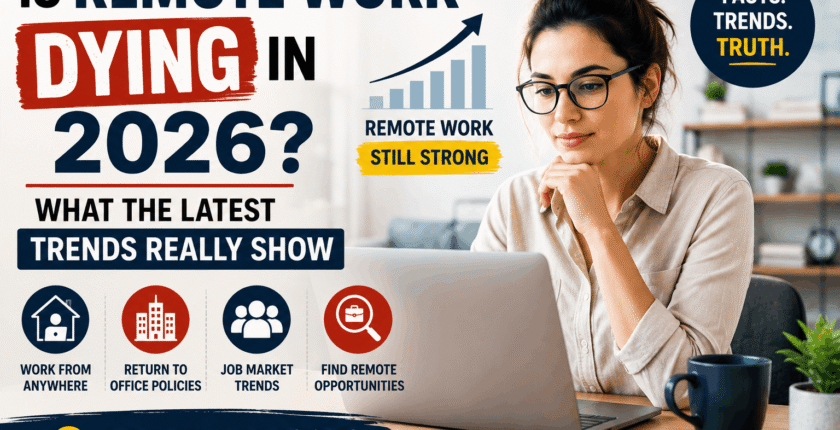
Is Remote Work Dying in 2026? What the Latest Trends Really Show
A few months ago, my former colleague Dave sent out a message to our WhatsApp group at 11 pm saying, “Guess I’m getting an office again.” They had just issued a mandate that everyone return to the office without compromise or discussion. A little later, three more individuals from the same thread inquired about the same thing.
I know, I get you. In the span of weeks, there are yet more stories of major companies doing away with remote work. Companies such as Amazon, JPMorgan, and Dell have made their remote workers ineligible for promotions if they stay remote.
That is why the first thing that I did when I realized that everyone was getting into a tizzy was go and read the employment data. What I found didn’t match the mood in that group chat at all.

The Headlines Are Real. Because That’s Not All to the Story
Let us begin with some facts since none of this is fiction.
Amazon brought its staff back to work for five days a week from January 2025. JPMorgan followed not long after. Dell quietly created a two-tier system where staying remote means your promotion track stalls. Paramount reportedly paid out enormous severance packages to employees who chose to leave rather than return full-time.
Then there’s Instagram. In December 2025, Meta announced that the employees working at Instagram based in the United States would be expected to come to work on all five weekdays starting from 2nd February 2026. Here’s the detail that got lost in most of the coverage: this only applies to Instagram. The rest of Meta, including Facebook and WhatsApp, is still on the three-day hybrid policy it’s had since 2023. A lot of “Meta ends remote work” headlines were technically about one product team, not the whole company.
That distinction matters more than it sounds like it should. A lot of the scariest headlines are actually about one division, one bank, or one industry, dressed up to sound like a universal trend.
What the National Numbers Actually Show
Here’s where it gets interesting. The Minneapolis Federal Reserve Bank has looked at Census data that compares 2024 and 2025, and the total number of people who work remotely has remained roughly 22% of all the working Americans in those last two years. That is no typographical error. The country-wide number hasn’t changed much despite the headlines.
What actually happened is more uneven than “remote work is ending.” Some sectors lost remote workers, others gained them. Professional services and healthcare actually saw growth in their remote-working population between 2024 and 2025, while public administration and the information sector saw declines. The information sector’s drop lines up almost exactly with the RTO waves we keep hearing about from big tech.
The biggest single collapse wasn’t corporate at all. It was government. A federal executive order at the start of 2025 required agencies to bring employees back in-person, and multiple state governments followed with their own mandates. If you strip out the federal workforce, a huge chunk of the “remote work is disappearing” narrative gets a lot quieter.
Stanford’s WFH Research group modeled something I found genuinely reassuring: even if every publicly announced RTO mandate across every company got fully implemented, the total effect on the national share of remote workdays would be less than half a percentage point. That’s the difference between background noise and an actual collapse.
The Truth Part (That’s Annoying)
All right, maybe the alarmist media isn’t right about everything. However, one undeniable thing has taken place and should be stated directly, as this is precisely what influences your career prospects.
There are fewer new job openings offering remote positions than there used to be a few years ago. Robert Half’s very own analysis of the number of postings has shown that in 2026, through the first half of the year, the trend is strongly biased toward completely on-site job listings, in contrast to last year. Multiple job market analysis tools, while their precise percentages may differ slightly, show the same thing: the percentage of newly advertised jobs marked as remote decreased from the previous peak in 2022.
Here is the important distinction to keep in mind: This does not mean that workers are less interested in remote positions or that employers are less in need of remote workers. Rather, it means a shift in how those positions are sold by employers looking to hire.
Indeed, positions could very well be remote when you have already applied to them, negotiated them, or even been promoted into them.
However, the desire for existing remote jobs remains just as strong as ever. Every serious tracker on this, whatever their disagreement on the exact percentage of remote postings, agrees that remote roles pull in dramatically more applications per posting than equivalent in-office roles. So you end up with fewer visible openings and a lot more people applying to each one. That combination is what makes the job hunt feel brutal even while the underlying telework rate hasn’t really budged.

Where the Split Actually Lives
This is the part I wish more coverage focused on: it’s not “remote work” as a single thing rising or falling. It’s splitting into two very different worlds.
On one side, you’ve got large, legacy, often finance- or government-adjacent employers pulling back hard and loudly. Goldman Sachs has required full-time office attendance since 2022. Amazon, JPMorgan, and now Instagram followed with their own hard mandates. A JLL survey found that the share of Fortune 100 companies requiring five-day office attendance jumped dramatically compared to just a few years ago.
On the other side, there’s a whole tier of companies that never wavered, because remote isn’t a policy for them; it’s the entire operating model. I wrote a full rundown of companies like this in 10 Companies Hiring Fully Remote Workers Right Now — places like GitLab and Automattic that don’t have a headquarters to summon anyone back to. The tech industry as a whole, including these remote-native companies, still runs at a remote-or-hybrid rate far above the national average.
Smaller and mid-sized companies also tend to hold onto flexibility longer than giant corporations, mostly because they don’t have the real estate overhead pushing them to justify office leases, and they can’t out-salary big employers, so remote flexibility is one of the few competitive advantages they have left in hiring.
How I’d Actually Job Hunt in This Climate
If you’re looking for remote work right now, here’s the actual process I’d use, based on what’s changed.
Step 1: Stop reading the mood-off headlines about one or two companies. A JPMorgan mandate tells you about JPMorgan. It doesn’t tell you what a 40-person healthcare software company two states away is doing.
Step 2: Target remote-native companies over recently-reversed ones. The large firms that have just reversed their WFH policies will be more prone to tightening than relaxing their policies. Those that were originally founded as remote businesses will have far less reason to change direction.
Step 3: Apply quickly and get referrals. In an era where there are more candidates applying to less visible remote work, the element of time is critical. A referral skips you past a chunk of the flooded applicant pool entirely.
Step 4: Get specific about what “hybrid” actually means before you apply. Some “hybrid” listings mean two flexible days a month. Others mean a near-full-time office with a nice label. Ask straight away in your initial conversation: How many in-person working days are there, and will that number increase?
Step 5: Watch a couple of real indicators instead of vibes. The Bureau of Labor Statistics telework figures and outlets like Indeed’s Hiring Lab publish actual data on this regularly. It’s a lot steadier than whatever’s trending on social media that week.
Step 6: Don’t confuse a contractor gig with a full-time remote job. Independent contractor and 1099 remote work are real and valid, but they’re a different arrangement with different tax and benefits implications than a salaried remote role. Know which one you’re evaluating.

What Happened With Dave
If anything, things weren’t quite so grim for Dave. His company’s mandate was real, but it turned out to apply to one specific office location tied to a lease renewal, not the whole company. In the end, he managed to negotiate a halfway deal for two days a week rather than what he wanted but far better than the full-time comeback that he feared at 11 pm.
This isn’t the takeaway from that episode: “Don’t worry—everything is fine.” The important point here is how the actual policy is always more limited and flexible than the one discussed in your WhatsApp group at 11 pm.
Mistakes to Avoid
- Abandoning your job search remotely out of fear after reading a scary news story about an employer you don’t even work for. Look into the real policy, the real company, and the real range before freaking out.
- Only applying to giant, recognizable brands. They’re the ones pulling back hardest and getting the most competition per opening.
- Treating “hybrid” as a synonym for flexible. Ask for the specific in-office day count before you invest time in the process.
- Assuming demand for remote work has dropped. The data says the opposite — applicant competition for remote roles is as intense as ever.
- Going through without vetting because you are in a rush. The tighter the job market, the more that scam advertisements posing as legitimate firms crop up, because desperate candidates operate in haste and are less curious. If you have not done so already, it would do you some good to check out how to find legitimate work-from-home opportunities.
Closing Remarks
Remote work isn’t dying. It’s stratifying. A handful of massive, headline-grabbing companies are retreating loudly, and government telework took a real hit from policy changes. Meanwhile, an entire tier of smaller companies and remote-native employers never blinked, and the national telework rate has barely moved in years.
What’s genuinely gotten harder is competition for the visible remote listings that do exist, since fewer companies are leading with “remote” in the job title even when the actual work still ends up flexible. That’s a real, practical problem worth planning around. It’s just a different problem than the one the headlines are selling.
If Dave’s group chat panic taught me anything, it’s that the fastest way to lose a remote job you don’t even have yet is to make decisions based on someone else’s company’s press release instead of your own actual options.