
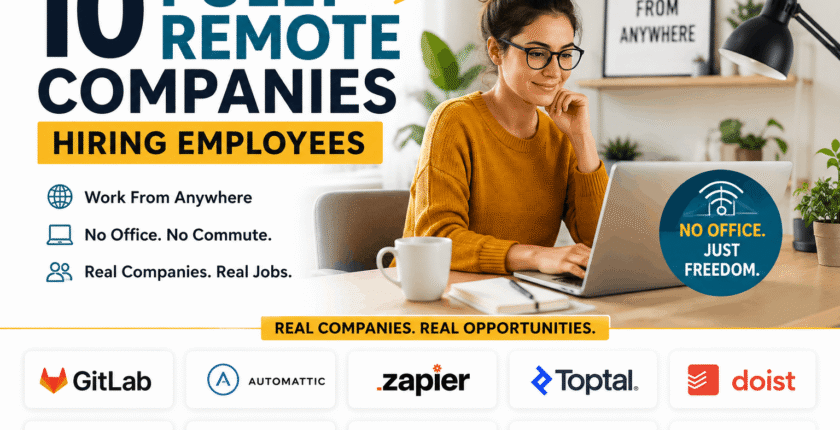
Ten Businesses That Are Hiring Remote Employees Right Now (Will Never Have an Office)
This is because when my neighbor showed me job postings on her phone last month, I always responded by saying, “No, this isn’t really remote.” She’d found a “remote marketing coordinator” role, all excited, until we got three lines into the description and hit “must be able to commute to our Austin office twice a month for team days.”
That’s not remote. That’s Hybrid wearing a costume.
I went through the same confusion when I first started looking for fully remote work. Half the listings that say “remote” quietly mean “remote, as long as you live near one of our offices and don’t mind driving in sometimes.” It took me way longer than it should have to figure out which companies actually mean it when they say no office, ever.
So I put together a list of companies that are genuinely, permanently, structurally remote. Not “remote during onboarding.” Not “remote for now.” This is an organization that is constructed without any kind of central office whatsoever, because literally you don’t have anywhere to go because there is no office.

“Remote-friendly vs. fully remote: Let’s figure out what the difference between them is.”
Simple explanation, because this always confuses people.
A remote-friendly company still has offices, and “remote” is a policy they could reverse. A lot of big names loosened up around 2021 and have been slowly walking it back since—Amazon and Disney are two well-known examples of companies that pulled back on remote flexibility over the past couple of years.
A fully remote, no-office company was built this way from day one or restructured entirely around it. There’s no headquarters to summon you back to. That’s a structural difference, not a mood the company might grow out of.
That’s the list, not necessarily in any ranking order, but just from what I have researched, applied for, or seen friends go through the process of.
1. GitLab
GitLab is an organization that develops DevOps software and operates as the largest all-remote company in the world. The uniqueness of GitLab lies in the transparency of the company because the GitLab employee handbook is entirely public, and you can learn how the company recruits people, how the company conducts its meetings, and how time zones work before you even decide to apply there. In my case, I read some parts of the employee handbook before my interview just to get better prepared for the interview. There are positions available at about.gitlab.com/jobs.
2. Automattic
This company runs the WordPress.com platform, WooCommerce, and Tumblr. It has been decentralized since its inception, having employees from about 100 different countries with no actual headquarters. A friend of mine went through their hiring process for a support role, and the standout part was a real paid trial project before any final offer — you actually do a slice of the job first. This may be a bit longer than a normal hiring process, but it gives each party an idea of what to expect. You can find openings at automattic.com/work-with-us.
3. Zapier
What Zapier does is connect applications together and allow their users to automate their tasks. This company has never had a physical office, not even when they were new. Also, they have been a bootstrapped business, and this is something very uncommon for such an established company. Zapier always posts salary brackets in the job posting itself, which other companies need to do. Positions are at zapier.com/jobs.
4. Toptal
It’s well-known for providing a platform that matches up freelance developers, designers, and finance professionals with businesses, but the organization behind Toptal operates entirely remotely, without any physical office at all. Coming from a freelance or contractual background? Interviewers at Toptal tend to really appreciate that kind of experience.
5. Doist
Doist produces Todoist and Twist, and they have always worked remotely because they were founded in 2007 before remote work became cool. They also follow an “async-first” policy, where most of the communication takes place through written communication rather than live interaction. If you don’t like being on one video call after another, this might be something you want to try.

6. Buffer
Buffer makes social media scheduling tools, and it’s famous in remote-work circles for radical transparency — public salary formulas, open financial dashboards, the whole thing. I found their transparency page genuinely useful just as a case study on how a distributed company can run without secrecy. It can give you a glimpse of the culture. at buffer.com/journey.
7. Close
Close builds CRM software for sales teams and has been fully remote since 2013. It’s a smaller team than some of the others on this list, which, in my experience, means a more personal hiring process—fewer rounds, but each one goes deeper.
8. 10up
10up is a digital agency that develops and maintains WordPress websites for big companies and has been working in a completely distributed way from its inception. The work of agencies usually involves working on projects with deadlines, so if you want something a little more structured than a SaaS company offers, this one might interest you.
9. Hotjar
Hotjar creates behavior analytics software to help businesses understand how visitors are really using their websites. It’s fully remote with team members across dozens of countries, and like a few others here, it leans heavily on written documentation over live meetings to keep everyone aligned across time zones.
10. LiveOps
This one’s different from the rest and worth knowing about if coding or SaaS experience isn’t your background. LiveOps connects people with virtual call center work—customer service, insurance support, and retail help lines—for well-known brands, entirely from home. The catch, and it’s an important one, is that you’re not an employee. You work as a 1099 independent contractor, which means you handle your own taxes and don’t get benefits like a traditional job would. It’s a real option for flexible, no-office work, just a genuinely different arrangement than the salaried roles above. Details are at join.liveops.com.

How I’d Actually Go About Applying
Finding the company is step one. Actually getting hired at one of these is a different skill. Here’s the process I use now.
Step 1: Read the culture page before the job listing. Companies like GitLab and Buffer publish their internal handbooks. Skim them. It tells you what the interview will actually probe for.
Step 2: Check your time zone against theirs. Some of these companies genuinely don’t care where you live. Others expect a certain number of overlapping hours with a core team. Ask this directly if it’s not stated.
Step 3: Prove you can work without supervision. With no boss around to come by and oversee your work, these companies will conduct interviews for people with self-reliance. Here are some instances in this regard: the work that you have done individually during your freelancing career, participation in open-source software projects, and so forth.
Step 4: Practice clear writing.
Async-first companies communicate mostly in writing. Your application, your cover letter, and even your typos are basically an audition for how you’ll communicate day to day.
Step 5: Expect a longer process, not a shorter one. Interviewing at Automattic, GitLab’s stages, and Toptal’s vetting process—companies that are entirely virtual will often conduct even more thorough interviews than those with traditional offices since fixing a poor hiring decision virtually becomes difficult.

Mistakes to be Avoided
- Assuming “remote” in the title means no office ever. Always check the actual job description for hybrid requirements or “occasional travel.”
- Applying without checking the company’s actual size and country restrictions. Some of these hire globally; others are limited to specific countries for tax or legal reasons.
- Treating the interview like an in-person one. Video call etiquette, written communication samples, and time zone flexibility matter more here than a firm handshake ever would.
- Confusing a contractor role with employment. LiveOps-style gigs are legitimate, but they’re not the same as a salaried job with benefits—go in knowing which one you’re applying for.
- Skipping research on legitimacy. Even with well-known names, always double-check you’re on the actual company’s career page and not a copycat listing. I did a complete description on how to detect fake postings for working from home in the section on finding legitimate work-from-home opportunities, which works hand-in-hand with this list.
Closing Remarks
None of these companies are secret. They’re not hidden gems nobody knows about. What these businesses all share is that they’ve managed to build their whole business around not having a physical space, which impacts the way they hire, communicate, and even who succeeds within the company.
If you’ve worked for years in an office setting, the transition will be greater than you might think because you won’t have the hallway chats or any office politics. It’s a different kind of work, not just the same job minus a commute.
But if you’ve ever found yourself more productive at 11 pm in your own kitchen than at 2 pm under fluorescent lights, one of these ten is probably worth a real look.