
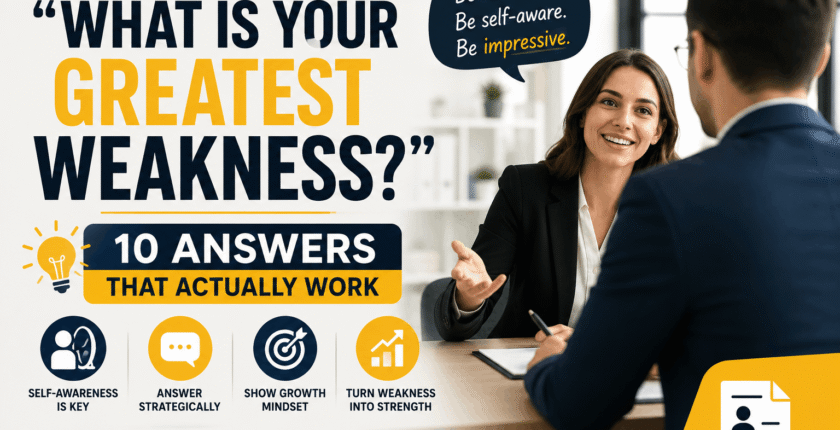
“How to Answer ‘What Is Your Greatest Weakness?'”: 10 Answers that Actually Work
Some years ago, I found myself sitting opposite a hiring manager from a marketing firm, sweating profusely into the only decent-looking suit I own, when she posed the dreaded question of “So, what would you say is your greatest weakness?”
As I was instructed by every career advice website I’ve ever read, I gave her a smile and replied, “Well, I’m a perfectionist. I just care too much about getting things done right.”
She didn’t even take notes. She just sort of…nodded thoughtfully, as if to say, “I believe you.” Well, that must be the same dog who ate all your homework. “Now, needless to say, I didn’t get the job. But I have to say I really cannot blame her either. It has become such a common response by job applicants that it is actually becoming a joke to human resource managers.
Type “worst interview answers” into Google, and this answer appears in almost every list. But here’s the thing nobody tells you: the problem isn’t that “perfectionist” is a bad trait. The problem is that everyone says it as a way to avoid actually answering the question.
I have been on the other side of the table as well, trying to help a friend fill their small content team, and seen this same question stump highly qualified individuals. And that’s why I’m going to take you through everything that you need to know about how to actually ace your interview.

Why Does This Question Appear to Be Tricky?
It is somewhat tricky, although perhaps not in the sense that one would expect.
Interviewers are not there to trick or fool you into revealing something that will cost you your chances. The fact is, most interviewers ask this simply to judge one thing: whether you are self-aware and coachable. That’s it. They’re not expecting a confession. They’re expecting honesty wrapped in maturity.
The two ways people mess this up are pretty predictable:
Mode one — the fake weakness. “I work too hard.” “I care too much” and “I am too much of a perfectionist” are clear indications that you didn’t give the question any thought, and this is evident to the interviewer.
Mode two — the oversharer. This is the other extreme, where someone says something like “I have really bad anxiety, and sometimes I just can’t get out of bed” in a first-round interview. I’ve seen this happen, and while I respect the honesty, it’s the wrong setting for it. An interview isn’t therapy, and TMI answers can genuinely cost you the job, fairly or not.
The sweet spot is somewhere in between—real but professional. Honest, but strategic.
The Framework I Actually Use Now
After that blazer-and-perfectionist disaster, I built myself a simple three-part structure. I still use it today, even for interviews I do for freelance clients.
- Name one weakness that is actually real, not a fake one to make yourself look better.
- Explain what you are doing about it – an app, a process, a method, anything that shows you are addressing the weakness.
- Include one tiny achievement or example of how this is helping.
It’s that simple. At most three sentences. It is not supposed to be a lecture or some kind of TED talk on your process of self-development. No, it should be more like this: Here’s the situation, here’s what I’ve been doing, and here’s where I’m at.

10 Real Answers that Work (and Why)
1. “I always agreed to do anything, which resulted in burnout.”
This one is common, but it works when you add the fix: “Now I use a simple priority list — I check what’s due this week versus this month before I agree to anything new.” Recruiters love this format since overcommitting is something they can relate to and fix.
2. “I’m not a natural public speaker.”
This is something you should embrace rather than hide. “Last year I attended a Toastmasters group in my area, and I’ve managed to give two presentations in my old job, which I think exceeded my expectations.”
3. “Sometimes I find myself getting impatient with lengthy meetings without a clear agenda.”
This could be used as a strength as well, but only if said correctly: “I find that sending out an agenda prior to my meetings has decreased our meeting time by almost half. ” Avoid saying this if you will be working under a boss who enjoys long meetings.
4. “I sometimes struggle to delegate.”
Very common for people moving into management. Follow up by saying, “I have begun using Asana to manage my tasks, as I wish to get an insight into what my team is doing rather than having to manage it myself, as it’s faster.”
5. “I’m a little bit too sensitive about any kind of constructive feedback initially.”
That is a genuine statement, and it also talks about human weaknesses. Add: “It has helped me become more approachable by taking a day to process the information given.”
6. “I’m still getting more comfortable with data and spreadsheets.”
If you’re not in an analytical position, that’s okay to say. Talk about what you’ve been doing: “I have been taking an Excel class for free on YouTube and applying it to real-life reports at work.”
7. “I can get so involved with the work that I lose track of time.”
This is certainly something that many artists and technicians do. Follow up with “I have started using an application named Pomodoro Timer to break down my work into intervals, and strangely enough it has increased my efficiency.”
8. “Previously I was avoiding tough talks with colleagues.”
This is something most relatable to those who are people-pleasers. Proceed to add, “I have read a book on this called Crucial Conversations, and I have started having short conversations.”
9. “I am not always the fastest learner for completely new software.”
Especially in cases where the job involves new software. It exhibits humility and does not exclude oneself from the position by saying, “But then once I’ve learned the software, I’ll become the default support person.”
10. “Sometimes, I overload myself because I don’t like to say no.”
Also similar to #1, yet worthy of note for its relatability, especially among younger people or people who have changed careers recently. Include, “I have been wondering if the new job aligns with my top three priorities.”
Choosing the Right One for You
Do not just copy from the list above!
This is how I actually help friends who are preparing for interviews:
Step 1: Write down three real things that have tripped you up at work in the last year. Not your worst nightmare scenario — just genuine, everyday friction points.
Step 2: Scratch off whatever isn’t essential to the role. If you’re interviewing for a job in accounting, you don’t want to say “Well, I’m no good at math.” That’s not modesty; it’s a warning sign.
Step 3: With whichever one you’re left with, then, ask yourself this question: What did I do about that? The answer shouldn’t be “Nothing”—choose another weakness or try something for a week before the interview.
Step 4: Say it out loud. Don’t write it down – say it. My practice routine involves making a voice memo of myself on my phone and then listening back. It’s rather embarrassing, but you will instantly know whether you sound practiced or not.
Step 5: Keep it under 30 seconds. If it takes you more time, then most probably you are talking too much.

Mistakes you should avoid
- Choosing a fabricated weakness in the guise of a strength is a classic mistake. Interviewers know all about the “work too much” answer, and it means you’re unprepared.
- Choose a weakness unrelated to the job. Applying for a position in customer service? Then it’s probably not a good idea to claim that you’re lousy at dealing with challenging people.
- Don’t ramble for ages. I’ve seen some applicants explain their weakness for three whole minutes without stopping. By minute two, the interviewer has generally stopped paying attention.
- Don’t mention an unresolved problem. Leave major personal issues for when you aren’t in the interview room.
- Avoid also going into an interview with false humility because it will be obvious to the interviewer if you’re not being genuine. If your answers sound unnatural, practice more or pick another weakness.
One Last Thing
The best answers I’ve heard—and given—weren’t clever wordplay. They were simply honest, somewhat specific, and demonstrated that the individual had indeed given some thought as to how they function and how they intend to improve.
This is what this question is all about. Not a confession, not a performance. Just proof that you know yourself well enough to keep growing. Once you stop trying to find the “perfect” weakness and start picking a real one with a real fix, this question stops being scary — it just becomes another normal part of the conversation.